May 27, 2010

What Type of Quilter Are You?


My favorite quilts are free-pieced out of scraps and strings, orphans and leftover strips. I love making something out of almost nothing and doing so without rules or regulations of any kind, and then giving almost everything I make away. So, I consider myself to be primarily a liberated, charity quilter.

But other quilters often find themselves at odds as to what constitutes their own primary style or focus. Do you see yourself as primarily a traditional quilter, modern or liberated quilter, or perhaps as an artist or art quilter?

I've discovered that stating one's opinion on what type of quilter they are can often lead to active discussions...even some disagreements...as each of us views ourselves, and others, differently than we do ourselves. So, I worked out some potential descriptive categories for "What Type of Quilter Are You?"

Traditional Quilter: You love the history of quilting and the patterns created and carried down through time by our pioneer ancestors and forebears. You tend to use pattern and love the look of traditional quilting above all other forms. Making a "Dear Jane' quilt once in your life is a goal of dedication, perseverance and the love of history,craft, and art form combined. But you might also adore the color values, tradition, and use of style and form in Civil War or Reproduction quilts.

Folk Art Quilter: Folk Art Quilters are often a blend or a fusing of many techniques used by traditional, applique, and art quilters. Utilizing expressive designs and often incorporating muted blending of colors with a predominant use of applique, one thinks of the bright modern, liberated works of Mary Lou Weidman or the rich traditional patterns and heart warming colors of Tonye Phillips. You love the comfy, cozy feel of quilts and quilting, but also have a deep inner need to express that love with characteristic symbols and meaning infused into the very story of the quilts you make.

Liberated Quilter:
Liberated quilters like to see themselves as using the best of two worlds...the traditions of those quilters who have gone before us, and a fun, free-piecing approach to intuitive quilting without following rules or allowing the inner quilt police person to constantly critique or challenge our work. An offset style of folkart quilting in many ways, it tends to incorporate more tone on tone fabrics or very brights. Liberated quilters often include free-pieced letters, and wonky versions of traditional patterns. The liberated stars, wonky churn dashes, strip pieced strings or flip and stitch flowers, animals, birds, and fish often distinguish them from other forms of quilting. Based on Gwen Marston's iconic 1994 book 'Liberated Quiltmaking', with her string quilting and liberated stars and houses, the movement has gone on to embrace Tonya Ricucci's free pieced alphabet letters, asterisks,houses, and stars and Bonnie Hunters more scrappy and fast pieced free piecing of traditional blocks, strings and orphan pieces, as well as developing a variety of techniques and styles among the many individual quilters.

Modern Quilter: Modern quilting is a new twist on the traditional art of quilting, once liberated and twice removed. This may mean something as simple as using a traditional quilt block and updating it in a fresh fun new way, using modern and often dramatic or unusual fabrics, modifying the block arrangement or even the scale of the block. It often uses bars and strips in unique ways where the emphasis is on design as a focus.The piecing could be improvisational and wonky, or it could be very exact and measured, following a pattern or creating your own. It might use a traditional stippling for quilting, clean straight lines, or a very free style. Fabrics could be up-cycled vintage sheets, custom digital printed fabric, or something from one of the modern fabric designers. Usually, there is a predominance of white spaces and fabric for a fresh, modern look such as that personified by Jacquie at Tallgrass Prairie Studio or the wonderful artistic combinations of Victoria, at the Silly Boo Dilly.

Art Quilter: Art quilters frequently began as artists in other media who discover a love of fabric or mixed media and use the craft of quilting as a form of multiple self expression. Often seeing the art quilt as the best of all worlds, they allow complete freedom of self-expression outside of any confines of the traditional pieced quilt. Using multi-dimensional techniques and materials, their quilts delight the senses and fill us with the wonder of 'how in the world did they do that' wonder. And I have to add, that amongst the most lovely of art quilts are those with specific value and purpose, such as those inspired by the amazing energy of Ami Simms and her Alzheimer's Art Quilt Initiative where we can all become art quilters with the creation of small 9"x12" art quilts or 4"x6" postcards and one can also become an art collector by bidding on or buying one of these lovelies;)

Fused Quilter: Sometimes viewed as art quilts, sometimes as fused applique' quilts, the art of fused quilting may have become famous due to the talent and hard work of the likes of the Chicago School of Fusing and Laura Wasilowski, Melody Johnson, and Frieda Anderson. It has developed as its own distinct quilt art form due to the bold use of design elements and color within the exploration of fused fabrics and modern quilted elements, as well as their creative use of music and theatre.

Crazy Quilters: To the Victorians the word "crazy" not only meant wild, but also broken or crazed into splinters. And 'Crazy Quilting' as a textile art is definitely creative and free-flowing by nature. As you add crazy quilt pieces and patches, you will often learn as much about the use of specific stitches or embellishments (and your love and obsession with them), as you will about your 'crazy quilting self' in the process. So, when it comes to self expression and liberation, being crazy is a whole lot of fun.

Kit Quilters: More of a subset to traditional quilters but often branching out into the kit quilting of even the Gees Bend approach, kit quilters may love the look of free pieced quilts but are not always ready to work from scratch and are more comfortable using patterns and quilt tutorials. With an interest in precision and color matching, as well as interest in saving time, they almost always buy their quilting materials pre-packaged or grouped.

Machine Quilter: The quilting culture is a living culture. Machine Quilters are wise to the fact that their ancestors jumped at the chance to use sewing machines to piece their quilts. The become 'machine quilters' when their quilting for others exceeds their piecing and quilting for themselves. They may give a nod to the past with their precise corner matching and the fact that they can finish a king size quilt in a month without the need of a quilting bee. Their ancestors would be amazed but most of us are simply jealous of their ability to be both creative and prolific at the same time.

Hand Quilters: Hand quilters really and truly are a special group of their very own. Those who love and honor this traditional and time consuming art, have to be commended and admired. Facing carpel tunnel, a bible bump and the beginning symptoms of arthritis, they steadfastly quilt away. You can often recognize them from the sheer number of band-aids on their fingers and the intent, somewhat glazed look on their faces. They are as much a 'group' as machine quilters, because while they mostly likely have their own favorite form of quilting...they stand out in their own group as hand quilters, as well. Traditionalists considering hand quilting a necessity, and an almost religious fervor and sense of responsibility to their cherished handiwork. For the true hand quilter, anything else is a cop out to time constraints or laziness ;) And yes, I have a tongue in my cheek and am totally jealous by their tiny stitches!!

My favorite quilt is ALWAYS the one that I'm working on, so I offer it here with a big shout out to the Spring Quilt Festival at Amy's (Park City Girl) Creative Side I had it bookmarked and on my list all week and I'm almost too late to enter in her virtual quilt show. It's always so much fun checking out all of the blogs and seeing the fabulous quilts. I just know I'll find even more categories to add to this post, later!

What Type of Quilter Are You?

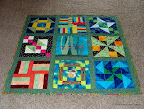
shown above:
My last little project out of cast-offs and orphans. A liberated collection of orphan blocks pieced together with a liberated free-pieced back. Symbolizing the layers that build up not only a quilt, but ourselves, as well as we quilt for a sense of individual accomplished and creative expression.

May 20, 2010

Singer Featherweight: Sewing Accessories Tutorial


My new (1964) Singer Featherweight sewing machine had barely come through the door...er chimney...in December and I couldn't wait to immediately make her a new set of 'clothes'.

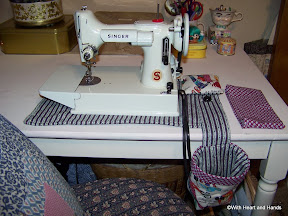
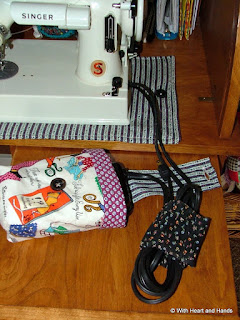
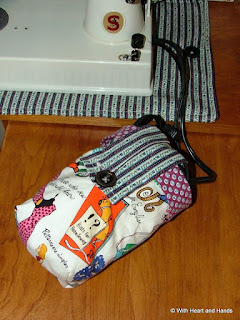
She is destined for being brought to many charity and guild group sew-along's so I knew that just like her bigger sister's, she needed accessories! Out came the gridded design table and sketches of a little table mat, a dual purposed snippets and scrap bag (that can later be unbuttoned for storing her little foot pedal as it tucks within her 'throat' area for travel) and a tiny wool filled pincushion...perfect for sitting on top of and protecting her motor casing during travel.

For those of you not familiar with these little 'green' featherweights (which is what they were called when production began in Clydebank, Scotland in 1964) they are actually a faint green that most people see as 'white' or perhaps 'slightly off-white' until something truly white is held up next to them. I have also heard the color called mint, aqua, and Singer originally called it turquoise!!!!

The traditional antique looking black model was produced from 1933 through the fifties and are the easiest to find, then the white or 'green' ones and finally the most rare...the tan ones.

I could have wished for a little black one ( as my local source had many black ones to choose from) but for reasons I can't explain, the little white one stole my heart. I changed my mind in a heartbeat after wanting a traditional black one for forever! Being frugal, I deliberated for almost a year before actually making the purchase...er, putting in on my Christmas wish list ;) And now, I feel so blessed to have one of my own and just adore her!

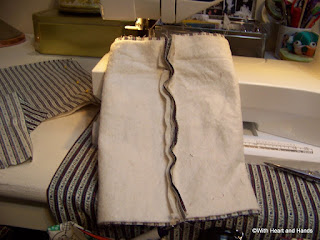
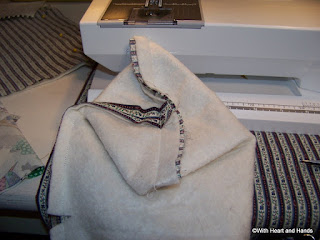
Here is a quick"photo tutorial" for the sewing of my featherweight sewing accessories and a link to all of the many other sewing accessories I have previously offered on this blog.  For this tutorial, I am only giving simple directions ..you use the pattern and the sizes given to cut your pieces in fabrics of your choice, then create the sections using the photos to figure out how I put it together. Check other patterns in my bigger list for more info or other peoples if my simple directions are too hard for you to follow. Mine is basic as I created it as I went along and you may want your own changes.


Supplies needed:
Assorted fabrics, thin fleece like batting, two buttons, one buttonhole ;)


Cutting Directions:

  Sewing machine mat--cut two pieces of fabric and one piece of fleece batting 10" x 18"

Snippets bag--for body cut one exterior piece, 1 lining piece, 1 batting piece (all 7" x 8")  a snippets cuff section, outside section, plus a lining section in an alternate prints 4" x 8"each, one section for hanging/buttoning strap 5" x 8".

Pillowcase sleeve for fold up bed of machine--it's cutting size ended up as 9" x 9". This gives allowance room for the turn under opening edge and 1/2" seams.


Pincushion/motor protector--small rectangle, 4" x 5" finished. It is placed on top of the motor in the back of the machine to protect it and as a tiny pincushion at group.


1. Mat: Sewing machine mat--
Cut two pieces of fabric and one piece of fleece batting each 10" x 18".
Sew together the 3 mat fabrics...the 'pretty or right side of the outside fabric you want to be able to see, to the pretty or right side of the back or lining section, sewn  to the fleece batting section. In other words, want your two primary fabric on facing each other, with the batting on top of the back or wrong side of one of them.

Sewing all around the sections together but leaving an opening for turning. Turn right sides out, batting enclosed within, then hand sew the turning opening closed.

 2. Snippets bag. Seam outside section on main seam closed. Do the same for the lining with fleece to wrong side.

Snippets bag--for body cut one exterior piece..7" x 8", 1 lining piece7" x 8", 1 batting piec e7" x 8"
plus a snippets cuff section...width you would like, an outside section, plus a lining section in an alternate prints all are  4" x 8"each, one section for hanging/buttoning strap 5" x 8".


3.Strap:
Make a little hanging tab or strap, as shown, and seam it into the lined cuff section. Stitch all pieces to the top opening of the bag.


4. Two buttons and one buttonhole
Add a little button to the mat and add a little buttonhole to the snippet bag strap for attaching it as shown in very top photo. I also added another button to the front of the snippet and scraps bag...the strap with the buttonhole that attached the snippet bag to the mat, can now be used to close up the little bag...holding the foot pedal inside for putting away or bringing to a sewing group.


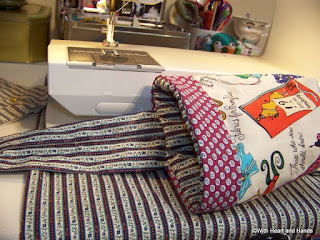
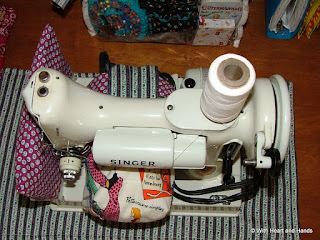
5. Make a simple little pillowcase bag to fit over the sewing machine bed which folds up for travel in a featherweight machine. Optional pincushion, shown above on right , can also be used to cushion the motor when packing the set up and traveling.


6. Pack as shown above. Sleeve onto bed, foot pedal tucked in snippet bag (which I unbutton from mat for travel) Little pincushion is shown above right by button is placed over motor when traveling.

Find this tutorial and others, including making a larger mat and snippet bag for a general sewing machine at: With Heart and Hands: Free Sewing Room Accessories Patterns


May 17, 2010

Bumble Beans Basics Quilt Gather


I am so happy to have been one of the earliest to donate a completed quilt to Basics Quilt Gather. But sad that there are currently only a few more names listed after mine. So many of you have donated house blocks such as the one shown above, to Victoria at Bumble Beans and V. has been fast and furiously turning them into completed quilts.

But now, she and her co-partners at Basics Inc. are striving to collect 700 completed quilts to give to homeless families in New York City...and frankly, they need many more.

It is a wonderful and amazing thing to give a homeless family the basics...a roof over their head, a table and a few chairs, a mattress to sleep on, a few pots and pans. But when we give them a quilt, we give them a gift from the heart and the hands of someone they've never met. Someone who cared enough about them to want to make time, spend time, and give time as a gift to show them that they are cared for.

Victoria has now brought in some wonderful people, companies, and gifts to further inspire us into action. By being the 5th person (out of 25 immediate gifts) to send a quilt, I won a $10 gift certificate to PINK CHALK FABRICS and one of these people, through a raffle, will also win a gift of 5 Vintage Feedsacks.

At 50 quilts, they will do a raffle for two $50 gift certificates from PINK CHALK FABRICS and at 75 quilts, 2 raffles.ONE raffle for a gift package from PURL SOHO (worth $75) which includes Last Minute Patchwork Quilted Gifts and 6 half yards of fabric!

At 100 quilts, long arm services from COTTAGE GARDEN QUILTS,

At 200 quilts,


The Janome Memory Craft MC200E 5×5″ Hoop Embroidery Machine!

All it takes is a donation of one quilt! Mine was the little baby quilt shown at the top of my collage above. A new place to live with a warm quilt for a new baby...how sweet is that? It made me feel so good to mail it, but that family will feel even better to have a home of their own with a roof over their head.


A quilt should be:

Homemade clean, completed,
100% cotton
New or Gently loved

SIZE? any size!

baby quilts
toddler quilts
twin,
full,
queen
king size quilts,
whatever size you want to give.


ANY look or design or pattern
These quilts will go directly to families
that are getting into new housing…
Send Quilts to:

Basic Housing, Inc.
Attn: Rosario Golden / BBINC
540 East 180th Street,
Bronx, NY 10457

PLEASE Include
your name, email & address
and value of your materials used.


My little baby quilt is small. It only cost me $15 to make and a few dollars more to mail. But I still made it inspite of a broken wrist, because I wanted and needed to help. The value of the gift given is so much greater than you can possibly imagine. Please contribute as you can to the amazing work that Victoria of Bumble Beans, Inc. is doing with her Basics Quilt Gather.

May 12, 2010

AAQI: Art Quilts and Alzheimer's Research

NOTE:

Sorry, the photos disappeared once AAQI closed it doors! We raised over ONE MILLION DOLLARS with the sale of these tiny art quilts!!!

I created and donated 75 small format art quilts and made over $4,500 for Alzheimer's research funding so I have many, many posts with missing photos! I will replace them as I can, bit by bit, over time!


Original post at this site:

I'm delighted to report that my 9" x 12" AAQI quilt Transitioning Between the Polarities earned $80 at auction towards Alzheimer's research funding. All Alzheimer's Art Quilt Initiative auctions are held from day 1 to 10 of each new month. The next one begins on June 1st and runs through the 10th. Every auction follows this pattern and all end at 10 pm of each final night.

Thank you and many blessing to Rene' of Rene Creates, who bought my AAQI quilt at auction.

Now that it has officially been released that no study to date has shown any way to prevent or to slow down the transmission or process of Alzheimer's...not playing chess, nor crossword puzzles, not Sudoku, not an active, exercising lifestyle..and unfortunately not even being Internet savvy or having an active life in blogging or message boards that keep our hearts, hands, and mind alive! Dang! This just is not right!!!!!!

All we can do now is support research and keep studying, testing, and maybe inventing and trying gene therapies to treat or hopefully alter this in the future!!! And research monies are still desperately needed. Our quilts, and the money they earn through AAQI make such a difference in so many ways!

My brother and others from my family have been visiting us in Oregon this week, just as this study was released, and as it was announced that Walgreen's Pharmacy would be putting out a DNA test kit...spit in a cup and mail it in...that would include the results of any of us being likely to get Alzheimer's. Scary times...would you want to know, or would you rather just prefer hope that you had somehow eluded your family probability? The debate on that and whether Walgreen's will face potential lawsuits on either reliability or accountability for errors will no doubt rage in the media!

I have two more AAQI quilts currently on sale. Apparently, if we send them in multiples at a time, this may happen... as it has to me. Rather than my other two being on the assignment for the June auction list, they were simply assigned a 'price' and are at Quilts for Sale on the AAQI website. Let's face it, Ami Simms and her volunteers do an outstanding job and any way she gets our quilts out there and up for sale to earn monies for Alzheimer's research is a good thing!

My other two art quilts are:


4946 - Liberated Rose
see Quilts For Sale


4948 - Alzheimer's: It's More Than Black and White
Update:Sale Pending! Thank you so much to somebody very wonderful :)


Check out the page, there are hundreds up for sale, and many of our Liberated Challenge
quilts are still on this list awaiting purchase. Yours might be there, and you aren't aware of it!

If you have quilts that have not yet sold from a previous auction, they can be found on the website under Look at All the Quilts for all other current quilts and postcards. Perhaps you can talk someone into buying one or buying one yourself for a friend or family member as a gift.

Supporters have been known to create art galleries of AAQI quilts, either buying back their own favorites or buying those of others that they would love to own or display...at home or at work. It makes a wonderful conversational grouping, as well as a way of showing support for this wonderful cause.

To see all of our own groups' donated quilts, check out my update complete with photos of each art quilt or postcard at our group blog at:

Liberated Quilters: Our AAQI Challenge Quilts Latest Update

Twitter Updates from Ami Simms at AAQI

follow the AAQI on TwitterLiberated Quilting Challenge

Get the latest news about the Alzheimer's Art Quilt Initiative on the AAQI BLOG!
For more frequent news follow the AAQI on FaceBook and Twitter.